
Big news brings Michael out of his Howard Hughes-like life and back into the spotlight when he charges his record company, Sony, is "racist". That's why his "Invincible" CD sold 2 million copies; Sony didn't promote him enough. He sez. We all get to gasp anew and ask the question - WTF?! Seems he's had his nose fixed,,,WHEW! and just got out of bed. As it is reported in the news it seems a bridge was built to widen the nasal passages. "Thank God!" the headlines say. Poor thing probably couldn't breathe! with those teensy bitty nostrils. Oh How Nice For Him! Perhaps his singing will improve, since his last album was 70 minutes of hiccups, grunts, fake crying and yips. One has to wonder why, with all his money, he can't seem to find plastic surgeons who are capable of actually doing plastic surgery. The "fixed" bridge appears as two lumpy lines and not what say, just for the sake of argument, a plastic surgeon might put in someone's face to create a nose bridge. Maybe this is a new trend in Breath-Rite Strip implants? One wonders what those Jutting Gill Bumps were on the sides of his jaw in 1997. Mike ruins his symmetry schtick with mismatched, lopsided eyes and lipstick like my senile Aunt Margaret wears. Music critics and even those in the record industry are saying OK, quite enough from this goof. There is even a TV special in the UK asking - If this is what the guy is doing to his outside, then what the hell is going on inside? What's happened to our Michael? 
Tracey Orvez took this photo in the parking lot of the Beverly Regent Hotel in Beverly Hills, California. She heard he was there so waited in hopes of seeing him. What a surprize it must have been to see The Mike, making his way to his limo dressed in only blue Jammies with snow flakes and polar bears on them. Always a good look for a star, I say. She asked if she could take his photo and he said sure...as long as she "stood well back".
I can't imagine why.
The publicly decried "third nostril", which appeared after the January plastic surgery (see above photo) that a few took time out of their busy days to write and inform me I was full of shit about, seems to be closing up but has left an obvious scar. The tip, which has been rumored (damn, I'm good) to have died and/or be a puttied-on prothesis looks to be dead tissue and/or a puttied on prothesis. Said Ms. Orvez: "He looked like a ghoul. When I had the picture developed, I was sick. The guy doesn't appear to have a nose."
Well, when you hack away at it for 15 years, that happens. But as my detractors write to me, I just put these vicious "lies" up because I'm "jealous". I am, boy howdy! I'm jealous I don't have whatever it is Mike's on to make his pupils the size of dinner plates. And I would really love some Polar bear and snowflake jammies myself. I wish Tracey mentioned if they had Feets in them or not! It's hell trying to find "fun" jammie feets pajamas when you're a grown up woman. How envious I am that a grown man can!


- The Latex Monkey In a Bad Wig Look of Planet Michael
The story is that Mike was in court because of a $21 million suit filed by his longtime promoter, Marcel Avram. He says Mike didn't show up for 2 concerts New Years Eve 2000 and Mike says he thought they'd been canceled so spent the night at home watching TV. ::rolling eyes:::
Jackson wore a surgical mask when entering and leaving the courthouse (gee..wonder why?). His former publicist says he routinely wears the mask "to protect his throat from pollution and germs". Like that reason in itself is a perfectly normal one. You see anyone else walking around with surgical masks on? Perhaps it's to hide the dead, rotting tip of his putty nose. Just to throw out an idea here. What I think we have here is the New Howard Hughes.
I like the wig though. I wasn't aware that the historic (3000 - 1200 BC) tradition of wearing dead marmots on your head had been revived. Are those caterpillar eyebrows? A 1000-yard stare? What a trend setter!
Thirty fans were allowed into the courtroom after winning that "honor" by Lotto.

We can all rest easier now - Michael got a new nose courtesy of Dr. Werner Mang, a German Plastic surgeon. Not only is Dr. Mang a gifted genius, but he doesn't mind talking about how he made Michael a new nose out of part of his ear. Just in time for Mike's child molestation trial, so he's looking good. Except for wearing white to court, and everyone knows you don't wear white after Labor Day.
So Dr. Mang says that Mike's "people" in 1998 about fixing his nose, since it was rotting off his face. Mang did the operation in the office of Michael's regular plastic surgeon, the one who ought to be sued for malpractice. He took a slice of cartilage from Mike's ear and slapped that puppy on his non-nose. He stated that Michael has an obsession with plastic surgery and wants to change from a black man to a white woman. He really said that, too. I really like this doctor. He thinks like me! Michael's regular plastic surgeon said that after every album, Mike had more surgery done and always wanted a thinner nose. Michael, however, still claims he only had two procedures done on his nose and nothing else. Not one thing. His face just sort of "squared out" and, mercifully, he got a much better wig.
Biography
1958–1975: Early life and The Jackson 5
Michael Joseph Jackson was born in Gary, Indiana (an industrial suburb of Chicago, Illinois) to a working-class family on August 29, 1958.[4] The son of Joseph Walter "Joe" and Katherine Esther (née Scruse),[4] he was the seventh of nine children. His siblings are Rebbie, Jackie, Tito, Jermaine, La Toya, Marlon, Randy and Janet.[4] Joseph Jackson was a steel mill employee who often performed in an R&B band called The Falcons with his brother Luther.[4] Jackson was raised as a Jehovah's Witness by his devout mother, but was later "disfellowshipped" for unbiblical actions.[4]
From a young age Jackson was physically and emotionally abused by his father, enduring incessant rehearsals, whippings and name-calling. Jackson's abuse as a child affected him throughout his grown life.[5] In one altercation — later recalled by Marlon Jackson — Joseph held Michael upside down by one leg and "pummeled him over and over again with his hand, hitting him on his back and buttocks".[6] Joseph would often trip up, or push the male children into walls.[6] One night while Jackson was asleep, Joseph climbed into his room through the bedroom window. Wearing a fright mask, he entered the room screaming and shouting. Joseph said he wanted to teach his children not to leave the window open when they went to sleep. For years afterwards, Jackson suffered nightmares about being kidnapped from his bedroom.[6]
Jackson first spoke openly about his childhood abuse in a 1993 interview with Oprah Winfrey. He said that during his childhood he often cried from loneliness and would sometimes get sick or start to vomit upon seeing his father.[7][8][9][10] In Jackson's other high profile interview, Living with Michael Jackson (2003), the singer covered his face with his hand and began crying when talking about his childhood abuse.[6] Jackson recalled that Joseph sat in a chair with a belt in his hand as he and his siblings rehearsed and that "if you didn't do it the right way, he would tear you up, really get you."[11]
Jackson showed musical talent early in his life, performing in front of classmates and others during a Christmas recital at the age of five.[4] In 1964, Jackson and Marlon joined the Jackson Brothers—a band formed by brothers Jackie, Tito and Jermaine—as backup musicians playing congas and tambourine, respectively. Jackson later began performing backup vocals and dancing; at the age of eight, he and Jermaine assumed lead vocals, and the group's name was changed to The Jackson 5.[4] The band toured the Midwest extensively from 1966 to 1968. The band frequently performed at a string of black clubs and venues collectively known as the "chitlin' circuit", where they often opened for stripteases and other adult acts. In 1966, they won a major local talent show with renditions of Motown hits and James Brown's "I Got You (I Feel Good)", led by Michael.[12]
The Jackson 5 recorded several songs, including "Big Boy", for the local record label Steeltown in 1967 and signed with Motown Records in 1968.[4] Rolling Stone magazine later described the young Michael as "a prodigy" with "overwhelming musical gifts", noting that Michael "quickly emerged as the main draw and lead singer" after he began to dance and sing with his brothers.[13] Though Michael sang with a "child's piping voice, he danced like a grown-up hoofer and sang with the R&B/gospel inflections of Sam Cooke, James Brown, Ray Charles and Stevie Wonder".[13] The group set a chart record when its first four singles ("I Want You Back", "ABC", "The Love You Save" and "I'll Be There") peaked at number one on the Billboard Hot 100.[4] During The Jackson 5's early years, Motown's public relations team claimed that Jackson was nine years old—two years younger than he actually was—to make him appear cuter and more accessible to the mainstream audience.[14] Starting in 1972, Jackson released a total of four solo studio albums with Motown, among them Got to Be There and Ben. These were released as part of the Jackson 5 franchise, and produced successful singles such as "Got to Be There", "Ben" and a remake of Bobby Day's "Rockin' Robin". The group's sales began declining in 1973, and the band members chafed under Motown's strict refusal to allow them creative control or input.[15] Although the group scored several top 40 hits, including the top 5 disco single "Dancing Machine" and the top 20 hit "I Am Love", the Jackson 5 left Motown in 1975.[15]
1975–1981: Move to Epic and Off the Wall
The Jackson 5 signed a new contract with CBS Records in June 1975, joining the Philadelphia International Records division, later Epic Records.[15] As a result of legal proceedings, the group was renamed The Jacksons.[16] After the name change, the band continued to tour internationally, releasing six more albums between 1976 and 1984. From 1976 to 1984, Michael Jackson was the lead songwriter of the group, writing hits such as "Shake Your Body (Down to the Ground)", "This Place Hotel" and "Can You Feel It".[12]
In 1978, Jackson starred as Scarecrow in the film musical The Wiz.[17] The musical scores were arranged by Quincy Jones, who formed a partnership with Jackson during the film's production and agreed to produce the singer's next solo album, Off the Wall.[18] In 1979, Jackson broke his nose during a complex dance routine. His subsequent rhinoplasty surgery was not a complete success; he complained of breathing difficulties that would affect his career. He was referred to Dr. Steven Hoefflin, who performed Jackson's second rhinoplasty and other subsequent operations.[19]
Jones and Jackson jointly produced Off the Wall. Songwriters included Jackson, Heatwave's Rod Temperton, Stevie Wonder and Paul McCartney. Released in 1979, it was the first album to generate four US top 10 hits, including the chart-topping singles "Don't Stop 'Til You Get Enough" and "Rock with You".[20] Off the Wall reached number three on the Billboard 200 and has since been certified for 7 million shipments in the US and eventually sold over 20 million copies worldwide.[21][22] In 1980, Jackson won three awards at the American Music Awards for his solo efforts: Favorite Soul/R&B Album, Favorite Male Soul/R&B Artist and Favorite Soul/R&B Single for "Don't Stop 'Til You Get Enough".[20] That year, he also won Billboard Music Awards for Top Black Artist and Top Black Album and a Grammy Award for Best Male R&B Vocal Performance (for "Don't Stop 'Til You Get Enough").[20] Despite its commercial success, Jackson felt Off the Wall should have made a much bigger impact, and was determined to exceed expectations with his next release.[23] In 1980, Jackson secured the highest royalty rate in the music industry: 37% of wholesale album profit.[24]
1982–1985: Thriller, Motown 25, We Are the World and business career
After Jackson's early 1982 contribution, "Someone In the Dark", to the blockbuster film E.T. the Extra-Terrestrial, which nabbed him a Grammy for Best Album for Children,[25] Epic issued his second album, Thriller. In what would turn out to be the apex of Jackson's career, the album remained in the top 10 of the Billboard 200 for 80 consecutive weeks, 37 at the peak. Seven singles from Thriller concurrently hit the Billboard Hot 100 top 10, including "Billie Jean", "Beat It" and "Wanna Be Startin' Somethin'".[26] Thriller went on to sell upwards of 109 million copies, making it the best-selling album of all time,[27][28][3] [29] causing Jackson biographer J. Randy Taraborrelli to muse that "at some point, Thriller stopped selling like a leisure item—like a magazine, a toy, tickets to a hit movie—and started selling like a household staple."[30]
The period of Thriller was an extraordinarily lucrative one for Jackson, whose lawyer John Branca had negotiated what he boasted then as the highest royalty rate ever in the music industry, approximately $2 per album. Meanwhile, Jackson raked in profits from The Making of Michael Jackson's Thriller, a documentary by Jackson and John Landis which quickly sold over 350,000 copies. In addition, Jackson began profiting from his image in earnest, as Michael Jackson dolls and other novelties hit the market.[31]
Beyond its record-breaking success among fans, Thriller instituted multiple changes within the music industry. One, it raised the importance of albums, while challenging notions about how many prospective hits an album should contain.[32] Two, it restored to the industry a sense of confidence in its ability to release high-level artistry during a time when profits had been sinking due to what one industry analyst called "the ruins of punk and the chic regions of synthesizer pop".[31] Three, it helped bring MTV into its heyday, even as MTV helped fuel Thriller's success. Four, Thriller paved the way for other well-profitable acts such as Prince.[33] In the end, in many ways, Jackson had become a one-man rescue team for the music business.[34] At its 25th anniversary, Thriller retained important influence over the music industry, artists, and American culture.[30]
On March 25, 1983, Jackson performed live on the Motown 25: Yesterday, Today, Forever television special, both with The Jackson 5 and on his own singing "Billie Jean". Debuting his signature dance move—the moonwalk—his performances during the event were seen by 47 million viewers during its initial airing, and drew comparisons to Elvis Presley's and the The Beatles' appearances on The Ed Sullivan Show.[35] The New York Times said, "The moonwalk that he made famous is an apt  metaphor for his dance style. How does he do it? As a technician, he is a great illusionist, a genuine mime. His ability to keep one leg straight as he glides while the other bends and seems to walk requires perfect timing".[36]
Jackson suffered a setback on January 27, 1984. While filming a Pepsi Cola commercial at the Shrine Auditorium in Los Angeles, Jackson suffered second degree burns to his scalp after pyrotechnics accidentally set his hair on fire. Happening in front of a full house of fans during a simulated concert, the incident was the subject of heavy media scrutiny and elicited an outpouring of sympathy.[37] PepsiCo settled a lawsuit out of court, and Jackson gave his $1.5 million settlement to the "Michael Jackson Burn Center" which was a piece of new technology to help people with severe burns.[37] Jackson had his third rhinoplasty shortly afterwards and grew self conscious about his appearance.[19]
On May 14, 1984, Jackson was invited to the White House to receive an award presented by U.S. President Ronald Reagan. The award was given for Jackson's support of charities that helped people overcome alcohol and drug abuse.[38] Jackson won eight awards during the 1984 Grammys. Unlike later albums, Thriller did not have an official tour to promote it, but the 1984 Victory Tour, headlined by The Jacksons, showcased much of Jackson's new solo material to more than two million Americans.[39] He donated his $5 million share from the Victory Tour to charity.[40]
Jackson co-wrote the charity single "We Are the World" with Lionel Richie, which was released worldwide to aid the poor in Africa and the US. He was one of 39 music celebrities who performed on the record. The single became one of the best-selling singles of all time, with nearly 20 million copies sold and millions of dollars donated to famine relief.[41]
While working with Paul McCartney on the two hit singles "The Girl Is Mine" and "Say Say Say", the pair became friendly, occasionally visiting one another. In one discussion, McCartney told Jackson about the millions of dollars he had made from music catalogs; he was earning approximately $40 million a year from other people's songs. Jackson then began a business career buying, selling and distributing publishing rights to music from numerous artists. Shortly afterwards, Northern Songs—a music catalog holding thousands of songs, including The Beatles' back catalog—was put up for sale.[42][43]
Jackson took immediate interest in the catalog but was warned that he would face strong competition. Excited, he skipped around saying, "I don't care. I want those songs. Get me those songs Branca [his attorney]". Branca then contacted the attorney of McCartney, who clarified that his client was not interested in bidding; "It's too pricey". After Jackson had started negotiations, McCartney changed his mind and tried to persuade Yoko Ono to join him in a joint bid, she declined, so he pulled out. Jackson eventually beat the rest of the competition in negotiations that lasted 10 months, purchasing the catalog for $47.5 million. When McCartney found out he said, "I think it's dodgy to do things like that. To be someone's friend and then buy the rug they're standing on". Reacting to that statement, biographer J. Randy Taraborrelli observed that McCartney made millions of dollars from the music of other people. He had more money than Jackson at that point so could have made a substantial bid for his own music and would not have suffered financial difficulties from Jackson owning the catalog.[42][44]
1986–1990: Tabloids, appearance, Bad, autobiography and films
In 1986, the tabloid press ran a story claiming that Jackson slept in a hyperbaric oxygen chamber to slow the aging process; he was pictured lying down in a glass box. Although the claim was untrue, Jackson disseminated the fabricated story himself. The singer was promoting his upcoming movie Captain EO and wanted to promote a science fiction image of himself.[45][46] Jackson had a fourth rhinoplasty and, wanting masculine features, had a cleft put in his chin.[19] Then he starred in the Francis Ford Coppola-directed 3-D film Captain EO. It was the most expensive film produced on a per-minute basis at the time, and was later hosted in Disney theme parks. Disneyland featured the film in its Tomorrowland area for nearly 11 years, while Walt Disney World screened the film in its Epcot theme park from 1986 to 1994.[47]
Jackson bought and befriended a pet chimpanzee called Bubbles, an act which extended his eccentric persona. In 2003, the singer claimed that Bubbles shared his toilet and cleaned his bedroom.[46] Later it was reported that Jackson bought the bones of The Elephant Man. Although untrue, it was a story that Jackson again disseminated to the tabloid press.[45][46] These stories inspired the pejorative nickname "Wacko Jacko", which Jackson acquired the following year. He would eventually come to despise the nickname. Realizing his mistake, he stopped leaking untruths to the press. However due to the profit being made, the media began making up their own stories.[46][48]
Jackson's skin was a medium-brown color for the entire duration of his youth, but starting in the early 1980s, his skin gradually grew paler. This change gained widespread media coverage, including rumors that Jackson was bleaching his skin.[7] In the mid-1980s, Jackson was diagnosed with vitiligo and lupus; the latter was in remission in Jackson's case, and both illnesses made him sensitive to sunlight. The treatments he used for his condition further lightened his skin tone, and, with the application of pancake makeup to even out blotches, he could appear very pale.[49] The structure of his face changed as well; several surgeons have speculated that Jackson had undergone multiple nasal surgeries, a forehead lift, thinned lips and a cheekbone surgery.[50] Changes to his face were, in part, due to periods of significant weight loss.[16] Jackson lost weight in the early 1980s because of a change in diet and a desire for "a dancer's body".[51] Witnesses reported that Jackson was often dizzy and speculated that he was suffering from anorexia nervosa; periods of weight loss would become a recurring problem for the singer later in life.[52] Some medical professionals have publicly stated their belief that the singer had body dysmorphic disorder, a psychological condition whereby the sufferer has no concept of how they are perceived by others.[49]
"Why not just tell people I'm an alien from Mars. Tell them I eat live chickens and do a voodoo dance at midnight. They'll believe anything you say, because you're a reporter. But if I, Michael Jackson, were to say, 'I'm an alien from Mars and I eat live chickens and do a voodoo dance at midnight,' people would say, 'Oh, man, that Michael Jackson is nuts. He's cracked up. You can't believe a damn word that comes out of his mouth.'"[53]
—Michael Jackson
With the industry expecting another major hit, Jackson's first album in five years, Bad (1987), was highly anticipated.[54] Bad had lower sales than Thriller, but was still a substantial commercial success. In the US, it spawned seven hit singles, five of which ("I Just Can't Stop Loving You", "Bad", "The Way You Make Me Feel", "Man in the Mirror" and "Dirty Diana") reached number one on the Billboard Hot 100 charts, more than any other album.[55] As of 2008, the album sold 30 million copies worldwide, including eight million shipments in the US.[22][56]
The Bad World Tour began on September 12, 1987, and finished on January 14, 1989.[57] In Japan alone, the tour had 14 sellouts and drew 570,000 people, nearly tripling the previous record of 200,000 in a single tour.[58] Jackson broke a Guinness World Record when 504,000 people attended seven sold-out shows at Wembley Stadium. He performed a total of 123 concerts to a total audience of 4.4 million people, and gained a further Guinness World Record when the tour grossed him $125 million. During the trip he invited underprivileged children to watch for free and gave donations to hospitals, orphanages and other charities.[57]
In 1988, Jackson released his first autobiography, Moon Walk, which took four years to complete. Jackson told of his childhood, his experience in The Jackson 5 and the abuse he suffered as a child.[59] He also spoke of his plastic surgery, saying he had two rhinoplastic surgeries and the surgical creation of a cleft in his chin.[51] In the book, he attributed the change in the structure of his face to puberty, weight loss, a strict vegetarian diet, a change in hair style and stage lighting.[51] Moonwalk reached the top position on The New York Times best sellers' list.[60] The musician then released a film called Moonwalker, which featured live footage, music videos, and a feature film that starred Jackson and Joe Pesci. Moonwalker debuted atop the Billboard Top Music Video Cassette chart, staying there for 22 weeks. It was eventually knocked off the top spot by Michael Jackson: The Legend Continues.[61]
In March 1988, Jackson purchased land near Santa Ynez, California to build Neverland Ranch at a cost of $17 million. The 2,700-acre (11 km2) property had Ferris wheels, a menagerie, and a movie theater. A security staff of 40 patrolled the grounds. In 2003, the property was valued at approximately $100 million.[13][62] In 1989, his annual earnings from album sales, endorsements, and concerts was estimated at $125 million for that year alone.[63] Shortly afterwards, Jackson became the first Westerner to appear in a television advert for Russia.[61]
Jackson's success resulted in his being dubbed the "King of Pop", a nickname conceived by actress and friend Elizabeth Taylor when she presented Jackson with an "Artist of the Decade" award in 1989, proclaiming him "the true king of pop, rock and soul".[64][65] President George H. W. Bush presented the singer with The White House's special "Artist of the Decade" award in recognition of Jackson's musical influence in the 1980s; Bush commended Jackson for acquiring a "tremendous following" among other achievements.[66] From 1985 to 1990, Jackson donated $500,000 to the United Negro College Fund, and all of the profits from his single "Man in the Mirror" went to charity.[67][68]
Jackson's live rendition of "You Were There" at Sammy Davis Jr. 60th birthday celebration received an Emmy nomination.[61]
1991–1993: Dangerous and Super Bowl XXVII
In March 1991, Jackson renewed his contract with Sony for $65 million; a record breaking deal at the time, displacing Neil Diamond's renewal contract with Columbia Records.[62] Jackson released his eighth album Dangerous in 1991. As of 2008, Dangerous has shipped 7 million copies in the US and has sold 32 million copies worldwide; it is the most successful New Jack Swing album of all time.[22][69][70] In the US, the album's first single "Black or White" was the album's biggest hit, reaching number one on the Billboard Hot 100 and remaining there for seven weeks, with similar chart performances worldwide.[71] The album's second single "Remember the Time" spent eight weeks in the top five in the US, peaking at number three on the Billboard Hot 100 singles chart.[72] In 1993, Jackson performed the song at the Soul Train Awards in a wheelchair, saying he had suffered an injury in rehearsals.[73] In the UK and other parts of Europe, "Heal the World" was the biggest hit from the album; it sold 450,000 copies in the UK and spent five weeks at two in 1992.[72]
Jackson founded the "Heal the World Foundation" in 1992. The charity organization brought underprivileged children to Jackson's ranch, to go on theme park rides that Jackson had built on the property after he purchased it. The foundation also sent millions of dollars around the globe to help children threatened by war and disease. The Dangerous World Tour began on June 27, 1992, and finished on November 11, 1993. Jackson performed to 3.5 million people in 67 concerts. All profits from the concerts went to the "Heal the World Foundation", raising millions of dollars in relief.[72][74] He sold the broadcast rights to his Dangerous world tour to HBO for $20 million, a record-breaking deal that still stands.[75] Following the illness and death of Ryan White, Jackson helped draw public attention to HIV/AIDS, something that was still controversial at the time. He publicly pleaded with the Clinton Administration at Bill Clinton's Inaugural Gala to give more money to HIV/AIDS charities and research.[76][77]
In a high-profile visit to Africa, Jackson visited several countries, among them Gabon and Egypt.[78] His first stop to Gabon was greeted with a sizable reception of more than 100,000 people in "spiritual bedlam", some of them carrying signs that read, "Welcome Home Michael".[78] In his trip to the Ivory Coast, Jackson was crowned "King Sani" by a tribal chief.[78] He then thanked the dignitaries in French and English, signed official documents formalizing his kingship and sat on a golden throne while presiding over ceremonial dances.[78]
One of Jackson's most acclaimed performances came during the halftime show at Super Bowl XXVII. As the performances began, Jackson was catapulted onto the stage as fireworks went off behind him. As he landed on the canvass, he maintained a motionless "clenched fist, standing statue stance", dressed in a gold and black military outfit and sunglasses; he remained completely motionless for several minutes while the crowd cheered. He then slowly removed his sunglasses, threw them away and began to sing and dance. His routine included four songs: "Jam", "Billie Jean", "Black or White" and "Heal the World". It was the first Super Bowl where the audience figures increased during the half-time show, and was viewed by 135 million Americans alone; Jackson's Dangerous album rose 90 places up the album chart.[7]
Jackson was given the "Living Legend Award" at the 35th Annual Grammy Awards in Los Angeles. "Black or White" was Grammy nominated for best vocal performance. "Jam" gained two nominations: Best R&B Vocal Performance and Best R&B Song.[72]
1993–1994: Sexual abuse accusations and marriage
Jackson gave a 90-minute interview with Oprah Winfrey in February 1993, his first television interview since 1979. He grimaced when speaking of his childhood abuse at the hands of his father; he believed he had missed out on much of his childhood years, admitting that he often cried from loneliness. He denied previous tabloid rumors that he bought the bones of the Elephant Man or slept in a hyperbaric oxygen chamber. The entertainer went on to dispel suggestions that he bleached his skin, admitting for the first time that he had vitiligo. The interview was watched by 90 million Americans, becoming the fourth most-viewed non-sport program in US history. It also started a public debate on the topic of vitiligo, a relatively unknown condition before then. Dangerous re-entered the album chart top 10, more than a year after its original release.[7][8][72]
Jackson was accused of child sexual abuse by a 13-year-old child named Jordan Chandler and his father Evan Chandler.[79] The friendship between Jackson and Evan Chandler broke down. Sometime afterwards, Evan Chandler was tape-recorded saying amongst other things, "If I go through with this, I win big-time. There's no way I lose. I will get everything I want and they will be destroyed forever...Michael's career will be over".[80] A year after they had met, under the influence of a controversial sedative, Jordan Chandler told his father that Jackson had touched his penis.[81] Evan Chandler and Jackson, represented by their legal teams, then engaged in unsuccessful negotiations to resolve the issue in a financial settlement; the negotiations were initiated by Chandler but Jackson did make several counter offers. Jordan Chandler then told a psychiatrist and later police that he and Jackson had engaged in acts of kissing, masturbation and oral sex, as well as giving a detailed description of what he alleged were the singer's genitals.[82]
An official investigation began, with Jordan Chandler's mother adamant that there was no wrongdoing on Jackson's part. Neverland Ranch was searched; multiple children and family members denied that he was a pedophile.[82] Jackson's image took a further turn for the worse when his older sister La Toya Jackson accused him of being a pedophile, a statement she later retracted.[83] Jackson agreed to a 25-minute strip search, conducted at his ranch. The search was required to see if a description provided by Jordan Chandler was accurate. Doctors concluded that there were some strong similarities, but it was not a definitive match.[83] Jackson made an emotional public statement on the events; he proclaimed his innocence, criticized what he perceived as biased media coverage and told of his strip search.[79]
Jackson began taking painkillers, Valium, Xanax and Ativan to deal with the stress of the allegations made against him. By the fall of 1993, Jackson was addicted to the drugs.[84] His health deteriorated to the extent that he canceled the remainder of the Dangerous World Tour and went into drug rehabilitation for a few months.[85] The stress of the allegations also caused Jackson to stop eating, losing a significant amount of weight.[86] With his health in decline, Jackson's friends and legal advisers took over his defense and finances; they called on him to settle the allegations out of court, believing that he could not endure a lengthy trial.[85][86]
Tabloid reaction to the allegations put Jackson in an unfavorable light.[87] Complaints about the coverage and media included everything from bias against Jackson, accepting stories of alleged criminal activity for money to accepting confidential leaked material from the police investigation in return for money paid.[88] On January 1, 1994, Jackson settled with the Chandler family and their legal team out of court, in a civil lawsuit for $22 million. After the settlement Jordan Chandler refused to continue with Police criminal proceedings. Jackson was never charged, and the state closed its criminal investigation, citing lack of evidence.[89]
Later that year, Jackson married singer-songwriter Lisa Marie Presley, the daughter of Elvis Presley. They had first met in 1975 during one of Jackson's family engagements at the MGM Grand, and were reconnected through a mutual friend in early 1993.[87] They stayed in contact every day over the telephone. As child molestation accusations became public, Jackson became dependent on Lisa Marie for emotional support; she was concerned about his faltering health and addiction to drugs.[84] Lisa Marie explained, "I believed he didn't do anything wrong and that he was wrongly accused and yes I started falling for him. I wanted to save him. I felt that I could do it."[90] In a phone call he made to her, she described him as high, incoherent and delusional.[84] Shortly afterwards, she tried to persuade Jackson to settle the allegations out of court and go into rehabilitation to recover—he subsequently did both.[84] Jackson proposed to Lisa Marie over the telephone towards the fall of 1993, saying, "If I asked you to marry me, would you do it?".[84] Presley and Jackson married in the Dominican Republic in secrecy; the parties denied they had been married for nearly two months.[91] The marriage was, in her words, "a married couple's life ... that was sexually active".[92] At the time, the tabloid media speculated that the wedding was a ploy to prop up Jackson's public image in light of prior sexual abuse allegations.[91] Jackson and Presley divorced less than two years later, remaining friendly.[93]
1995–1999: HIStory, second marriage and fatherhood
In 1995, Jackson merged his Northern Songs catalog with Sony's publishing division creating Sony/ATV Music Publishing. Jackson retained half-ownership of the company, earned $95 million upfront as well as the rights to even more songs.[43][94] He then released the double album HIStory: Past, Present and Future, Book I. The first disc, HIStory Begins, was a 15-track greatest hits album, and was later reissued as Greatest Hits — HIStory Vol. I in 2001, the second disc, HIStory Continues, contained 15 new songs. The album debuted at number one on the charts and has been certified for seven million shipments in the US.[95] It is the best-selling multiple-disc album of all-time, with 20 million copies (40 million units) sold worldwide.[71][96] HIStory received a Grammy nomination for best album.[97]
The first single released from the album was the double A-side "Scream/Childhood". "Scream" was a duet, sung and performed with Jackson's youngest sister Janet. The single had the highest debut on the Billboard Hot 100 at number five, and received a Grammy nomination for "Best Pop Collaboration with Vocals".[97] "You Are Not Alone" was the second single released from HIStory; it holds the Guinness World Record for the first song ever to debut at number one on the Billboard Hot 100 chart.[63] It was seen as a major artistic and commercial success, receiving a Grammy nomination for "Best Pop Vocal Performance".[97] In late 1995, Jackson was rushed to a hospital after collapsing during rehearsals for a televised performance; the incident was caused by a stress related panic attack.[98] "Earth Song" was the third single released from HIStory, and topped the UK singles chart for six weeks over Christmas 1995; it sold a million copies, making it Jackson's most successful single in the UK.[97]
In early 1996, the Anti-Defamation League (ADL) issued a press release charging Jackson with antisemitism regarding lyrics in the song "They Don't Care About Us", the fourth single from HIStory.[99] The song had originally been recorded with lyrics that included the phrase "Jew me, sue me", and "Kick me, kike me". The ADL complained and Jackson responded by saying he would re-record the lyrics before the album went into production. However the ADL's press release charged that Jackson had performed the song live and included the lyrics in question during the live performance.[99] The dispute over the lyrics upset long-time Jackson friend Steven Spielberg, who considered the song anti-semitic [100]
The HIStory World Tour began on September 7, 1996, and finished on October 15, 1997. Jackson performed 82 concerts in 58 cities to over 4.5 million fans. The show, which visited 5 continents and 35 countries, became Jackson's most successful in terms of audience figures.[57] During the Australian leg of the HIStory World Tour, Jackson married dermatologist nurse Deborah Jeanne Rowe, with whom he fathered a son, Michael Joseph Jackson, Jr. (also known as "Prince"), and a daughter, Paris Michael Katherine Jackson.[93][101] The pair first met in the mid-1980s, when Jackson was diagnosed with vitiligo. She spent many years treating his illness as well as providing emotional support. They built a strong friendship, then became romantically involved.[102] Originally there were no plans to marry, but following Rowe's first pregnancy, Jackson's mother intervened and persuaded them to do so.[103] After the couple divorced in 1999, with Rowe giving full custody rights of the children to Jackson, they remained friends.[104]
In 1997, Jackson released Blood on the Dance Floor: HIStory in the Mix, which contained remixes of hit singles from HIStory and five new songs. Worldwide sales stand at 6 million copies as of 2007, making it one of the best selling remix albums ever released. It reached number one in the UK, as did the title track.[105][106] In the US, the album was certified platinum, but only reached number 24.[22][97] Forbes placed his annual income at $35 million in 1996 and $20 million in 1997.[62]
Throughout June 1999, Jackson was involved in a number of charitable events. He joined Luciano Pavarotti for a benefit concert in Modena, Italy. The show was in support of the non-profit organization Warchild, and raised a million dollars for the refugees of Kosovo, as well as additional funds for the children of Guatemala.[107] Later that month, Jackson organized a set of "Michael Jackson & Friends" benefit concerts in Germany and Korea. Other artists involved included Slash, The Scorpions, Boyz II Men, Luther Vandross, Mariah Carey, A. R. Rahman, Prabhu Deva Sundaram, Shobana Chandrakumar, Andrea Bocelli and Luciano Pavarotti. The proceeds went to the "Nelson Mandela Children's Fund", the Red Cross and UNESCO.[108]
2000–2002: Label dispute, Invincible and third child
In 2000, Jackson was listed in the book of Guinness World Records for his support of 39 charities, more than any other entertainer or personality.[109] At the time, Jackson was waiting for the licenses to the masters of his albums to revert to him; this allowed him to promote his old material how he liked and prevented Sony from getting a cut of the profit. Jackson expected this to occur early in the new millennium, however, due to the fine print and various clauses in the contract, this revert date is still many years away. Jackson began an investigation, and it emerged that the attorney who represented the singer in the deal was also representing Sony, creating a conflict of interest.[106] Jackson was also concerned about another conflict of interest. For a number of years, Sony had been pushing to buy all of Jackson's share in their music catalog venture. If Jackson's career or financial situation were to deteriorate, he would have to sell his catalog. Thus, Sony had something to gain from Jackson's career failing.[110] Jackson was able to use these conflicts as leverage to exit his contract early.[106] Just before the release of Invincible, Jackson informed the head of Sony Music Entertainment, Tommy Mottola, that he was leaving Sony.[106] As a result, all singles releases, video shootings and promotions concerning the Invincible album were canceled. Jackson made allegations in July 2002 that Mottola was a "devil" and a "racist" who did not support his African-American artists, using them merely for his own personal gain.[106] He charged that Mottola had called his colleague Irv Gotti a "fat nigger".[111] Sony disputed claims that they had failed to promote Invincible with sufficient energy, maintaining that Jackson refused to tour in the US.[112]
Six years after his last studio album and after spending much of the late 1990s to early millennium out of the public eye, Jackson released Invincible in October 2001 to much anticipation. To help promote the album, a special 30th Anniversary celebration at Madison Square Garden occurred in September 2001 to mark the singer's 30th year as a solo artist. Jackson appeared onstage alongside his brothers for the first time since 1984.[113] The show also featured performances by Mýa, Usher, Whitney Houston, 'N Sync, and Slash, among other artists.[27] In the wake of the September 11, 2001 attacks, Jackson helped organize the United We Stand: What More Can I Give benefit concert at RFK Stadium in Washington, D.C. The concert was aired on October 21, 2001, and included performances from dozens of major artists, including Jackson, who performed his song "What More Can I Give" as the finale.[110] Invincible was a commercial success, debuting atop the charts in 13 countries and going on to sell approximately 10 million copies worldwide. It received double-platinum certification in the US.[22][71][110] However, the sales for Invincible were notably low compared to his previous releases, due in part to a diminishing pop music industry, the lack of promotion, no supporting world tour and the label dispute.[110] The album spawned three singles, "You Rock My World", "Cry" and "Butterflies", the latter did not have a music video.
Jackson's third child, Prince Michael Jackson II (also known as Blanket) was born in 2002.[114] The mother's identity was never released by Jackson, but he has said the child was the result of artificial insemination from a surrogate mother and his own sperm cells.[104] In November of that year, Jackson brought his new born son onto the balcony of his hotel room in Berlin, as fans stood below. Holding him in his right arm, with a cloth loosely draped over the baby's face, Jackson briefly extended the baby over the railing of the balcony, four stories above ground level, causing widespread criticism in the media. Jackson later apologized for the incident, calling it "a terrible mistake".[115]
2003–2007: Documentary, trial and business ventures
In 2003, Sony put out a compilation of Jackson's hits on CD and DVD. In the US, the album peaked at number 13 and was certified platinum by the RIAA; in the UK it was certified for shipments of at least 1.2 million units.[22][116] In a Granada Television documentary titled Living with Michael Jackson, the singer was seen holding hands and discussing sleeping arrangements with Gavin Arvizo, who would later accuse him of child sexual abuse.[117] In the same documentary Jackson was observed spending large amounts of money in an apparently frivolous manner, when he spent $6 million in a single store.[62] Shortly after the documentary aired, Jackson was charged with seven counts of child sexual abuse and two counts of administering an intoxicating agent in order to commit that felony; all charges regarded the same boy, Gavin Arvizo, who was under 14 at the time of the alleged crime.[117]
Jackson denied the sexual abuse allegations, saying that the sleepovers were in no way sexual in nature. Jackson's friend Elizabeth Taylor defended him on Larry King Live, saying that she had been there when they "were in the bed, watching television. There was nothing abnormal about it. There was no touchy-feely going on. We laughed like children and we watched a lot of Walt Disney. There was nothing odd about it."[118] During the investigation, Jackson's profile was examined by mental health professional Dr. Stan Katz; the doctor spent several hours with the accuser too. The assessment made by Katz was that Jackson had become a regressed 10-year-old and did not fit the profile of a pedophile.[119]
The People v. Jackson trial began in Santa Maria, California, two years after Jackson was originally charged. During this period the singer became dependent on morphine and Demerol, a dependency which he subsequently overcame. He also suffered from stress-related illnesses and severe weight loss, that would alter his appearance. The trial lasted five months, until the end of May 2005, he was acquitted on all counts.[120][121][122] Jackson then relocated to the Persian Gulf island of Bahrain as a guest of Sheikh Abdullah.[123]
Sony BMG released Visionary: The Video Singles to the European market: a series of 20 of his biggest hit singles of the 1980s and 1990s. Each single was issued weekly over a five-month period in DualDisc format (DVD video on one side, CD audio on the other), and the whole group of discs was made available as a boxed set afterwards.[124] The box set was released in the US on November 14, 2006.[125]
Reports of financial problems for Jackson became frequent in 2006 after the closure of the main house on the Neverland Ranch as a cost-cutting measure.[126] One prominent financial issue for him concerned a $270 million loan secured against his music publishing holdings. After delayed repayments on the loan, a refinancing package shifted the loans from Bank of America to debt specialists Fortress Investments. A new package proposed by Sony would have had Jackson borrow an additional $300 million and reduce the interest rate payable on the loan, while giving Sony the future option to buy half of Jackson's stake in their jointly owned publishing company (leaving Jackson with a 25% stake).[94] Jackson agreed to a Sony-backed refinancing deal, although details were not made public.[127] Despite these loans, according to Forbes, Jackson was still making as much as $75 million a year from his publishing partnership with Sony alone.[128]
One of Jackson's first documented public appearances since his trial was in November 2006, when he visited the London office of the Guinness World Records. He received eight records, among them "First Entertainer to Earn More Than 100 Million Dollars in a Year" and "Most Successful Entertainer of All Time".[63] Jackson was awarded the Diamond Award on November 15, 2006, for selling over 100 million albums, at the World Music Awards.[71] Following the death of James Brown, Jackson returned to the US to pay his respects. He, along with more than 8,000 people, paid tribute during Brown's public funeral on December 30, 2006.[129] In late 2006, Jackson agreed to share joint custody of his first two children with ex-wife Debbie Rowe.[130] Jackson and Sony bought Famous Music LLC from Viacom in 2007. This deal gave him the rights to songs by Eminem, Shakira and Beck, among others.[131]
I've been in the entertainment industry since I was six-years-old... As Charles Dickens says, "It's been the best of times, the worst of times." But I would not change my career... While some have made deliberate attempts to hurt me, I take it in stride because I have a loving family, a strong faith and wonderful friends and fans who have, and continue, to support me.[132]
—Michael Jackson
2008–2009: Milestones, real estate, planned return to live performance
To celebrate the 25th anniversary of Thriller, Jackson issued Thriller 25, comprised of original material from the album, re-mixes, the previously unreleased song "For All Time" and a DVD. Two singles were released to moderate success: "The Girl Is Mine 2008" and "Wanna Be Startin' Somethin' 2008". Thriller 25 was a commercial success, having done particularly well as a re-issue, peaking at number one in eight countries and Europe. It reached number two in the US, number three in the UK and top 10 on over 30 national charts.[133][134][135] It was ineligible for the Billboard 200 chart as a re-release, but entered atop the Pop Catalog chart, where it stayed for 11 non-consecutive weeks and had the best sales on that chart since December 1996.[136][137][138] In 12 weeks Thriller 25 sold over three million copies worldwide.[139] As of November 2008, US sales of Thriller 25 stood at 688,000 copies, making it the best-selling catalog album of 2008.[138]
To celebrate Jackson's 50th birthday, Sony BMG released a compilation album called King of Pop in various countries. These albums included tracks from Jackson's group and solo career, all voted for by fans. The albums had different tracklists, according to how the fans of each nation voted.[140][141] Although it was not released in the US, King of Pop did reach the top 10 in the vast majority of countries it was issued in. It also charted in other countries, albeit lower, from imported sales.[142][143]
Fortress considered a foreclosure sale of Neverland Ranch to service a loan Jackson owed on the property, but ultimately sold the loan to Colony Capital LLC. In November, Jackson transferred the title of Neverland Ranch to Sycamore Valley Ranch Company LLC. At the time of his death, Jackson still owned an unknown stake in the property—Sycamore Valley Ranch was a joint venture between Jackson and Colony Capital LLC—the loan Jackson owed was cleared, he acquired $35 million in the venture.[144][145][146]
2009: Death
On June 25, 2009, Jackson reportedly collapsed at a rented home in
Holmby Hills in
Los Angeles. After he collapsed, Jackson's personal physician, with him at the time, attempted to resuscitate him.
[147] Los Angeles Fire Department paramedics responded to a
911 call at 12:21 pm (
PST),
[148] arriving nine minutes later. Jackson was reportedly not breathing and
CPR was performed.
[149] Resuscitation efforts continued both en route to the
UCLA Medical Center, and after arrival at approximately 1:14 pm (20:14 UTC), for a further hour.
[147] Jackson remained in a
coma and died shortly after arrival.
[150] He was noted to have already been in
cardiac arrest by the paramedics who attended his house.
[149] Jackson was pronounced dead at about 2:26 pm local time (21:26 UTC).
[151] The cause of death is currently unknown.
The case was transferred to the Los Angeles coroner for investigation.[147] Jackson's body was transported by helicopter from UCLA to the LA Coroners offices in Boyle Heights.[152][153] The autopsy is scheduled for Friday, June 26, 2009.[151]
At the time of his death, Jackson was scheduled to perform 50 sold-out concerts to over one million people, at London's O2 arena, from July 13, 2009, to March 6, 2010. During a publicity press conference, Jackson made suggestions of possible retirement.[154] Randy Phillips, president and chief executive of AEG Live, had stated that the first 10 dates alone would have earned the singer approximately £50 million (about $100 million USD).[155]
Jackson's death caused an outpouring of grief among fans not seen since the deaths of Elvis Presley and John Lennon as fans gathered outside the UCLA Medical Center and his Holmby Hills home.[156] Fans also gathered in New York City outside the Apollo Theater[157] and in Detroit outside Hitsville U.S.A., the old Motown headquarters now the Motown Museum, where fans created a shrine.[158]
In the hours following Jackson's death, his record sales increased dramatically. His seminal album Thriller climbed to number one on the American iTunes music chart, while another eight have made it into the top 40.[159] In the UK, where Jackson would have performed less than three weeks after his death, fifteen of his albums occupied the top 15 spots on the Amazon music chart.[160]
Musical style and performance
Themes and genres
Steve Huey of Allmusic asserts that throughout his solo career, Jackson's versatility allowed him to experiment with various themes and genres.[161] As a musician, he ranged from Motown's dance fare and ballads to techno-edged new jack swing to work that incorporates both funk rhythms and hard rock guitar.[13] Unlike many artists, Jackson did not write his songs on paper. Instead he would dictate into a sound recorder; when recording he would sing from memory.[19][162] Several critics observed Off the Wall was crafted from funk, disco-pop, soul, soft rock, jazz and pop ballads.[161][163][164] Prominent examples include the ballad "She's out of My Life", and the two disco tunes "Workin' Day and Night" and "Get on the Floor".[163]
According to Huey, Thriller refined the strengths of Off the Wall; the dance and rock tracks were more aggressive, while the pop tunes and ballads were softer and more soulful.[161] Notable tracks included the ballads "The Lady in My Life", "Human Nature" and "The Girl Is Mine"; the funk pieces "Billie Jean" and "Wanna Be Startin' Somethin'"; and the disco set "Baby Be Mine" and "P.Y.T. (Pretty Young Thing)".[161][165][166][167] With Thriller, Christopher Connelly of Rolling Stone commented that Jackson developed his long association with the subliminal theme of paranoia and darker imagery.[167] Allmusic's Stephen Thomas Erlewine noted this is evident on the songs "Billie Jean" and "Wanna Be Startin' Somethin'".[166] In "Billie Jean", Jackson sings about an obsessive fan who alleges he has fathered a child of hers.[161] In "Wanna Be Startin' Somethin'" he argues against gossip and the media.[167] The anti-gang violence rock song "Beat It" became a homage to West Side Story, and was Jackson's first successful rock cross-over piece, according to Huey.[13][161] He also observed that the title track "Thriller" began Jackson's interest with the theme of the supernatural, a topic he revisited in subsequent years.[161] In 1985, Jackson wrote the charity anthem "We Are the World"; humanitarian themes later became a central component of his life and music.[161]
In
Bad, Jackson's concept of the predatory lover can be seen on the rock song "
Dirty Diana".
[169] The lead single "
I Just Can't Stop Loving You" was a traditional love ballad, while "
Man in the Mirror", an anthemic ballad of confession and resolution, improved on his earlier "We Are the World".
[54] "
Smooth Criminal" was an evocation of bloody assault, rape and likely murder.
[54] Allmusic's
Stephen Thomas Erlewine states that
Dangerous presents Jackson as a stark paradoxical individual.
[170] He comments the album is more diverse than his previous
Bad, as it appeals to an urban audience while also attracting the middle class with anthems like "
Heal the World".
[170] The first half of the record is dedicated to new jack swing, including songs like "
Jam" and "
Remember the Time".
[171] The album is Jackson's first where social ills become a primary theme; "Why You Wanna Trip on Me", for example, protests against world hunger,
AIDS, homelessness and drugs.
[171] Dangerous contains sexually charged efforts like "
In the Closet", a love song about desire and denial, risk and repression, solitude and connection, privacy and revelation.
[171] The title track continues the theme of the predatory lover and compulsive desire.
[171] The second half includes introspective, pop-gospel anthems such as "
Will You Be There", "Heal the World" and "Keep the Faith"; these songs show Jackson finally opening up about various personal struggles and worries.
[171] In the ballad "
Gone Too Soon", Jackson gives tribute to his friend
Ryan White and the plight of those with AIDS.
[172] HIStory creates an atmosphere of paranoia.[173] Its content focuses on the hardships and public struggles Jackson went through just prior to its production. In the new jack swing-funk-rock efforts "Scream" and "Tabloid Junkie", along with the R&B ballad "You Are Not Alone", Jackson retaliates against the injustice and isolation he feels, and directs much of his anger at the media.[174] In the introspective ballad "Stranger in Moscow", Jackson laments over his "fall from grace", while songs like "Earth Song", "Childhood", "Little Susie" and "Smile" are all operatic pop pieces.[173][174] In the track "D.S.", Jackson launched a verbal attack against Tom Sneddon. He describes Sneddon as an antisocial, white supremacist who wanted to "get my ass, dead or alive". Of the song, Sneddon said, "I have not—shall we say—done him the honor of listening to it, but I’ve been told that it ends with the sound of a gunshot".[175] Invincible found Jackson working heavily with producer Rodney Jerkins.[161] It is a record made up of urban soul like "Cry" and "The Lost Children", ballads such as "Speechless", "Break of Dawn" and "Butterflies" and mixes hip hop, pop and rap in "2000 Watts", "Heartbreaker" and "Invincible".[176][177]
Vocal style
Jackson sang since he was a child, and over time his voice and vocal style changed noticeably, either through puberty or a personal preference to align his vocal interpretation to the themes and genres he chose to express. Between 1971 and 1975, Jackson's voice "descended ever so slightly from boy soprano to his current androgynous high tenor".[13] In the mid-1970s, the singer adopted a "vocal hiccup" as seen in "Shake Your Body (Down to the Ground)". The purpose of the hiccup—somewhat like a gulping for air or gasping—was to help promote a certain emotion, be it excitement, sadness or fear.[15] With the arrival of Off the Wall in the late 1970s, Jackson's abilities as a vocalist were well regarded; Allmusic described him as a "blindingly gifted vocalist".[163] At the time, Rolling Stone compared his vocals to the "breathless, dreamy stutter" of Stevie Wonder. Their analysis was also that "Jackson's feathery-timbered tenor is extraordinarily beautiful. It slides smoothly into a startling falsetto that's used very daringly".[164] 1982 saw the release of Thriller, and Rolling Stone were of the opinion that Jackson was then singing in a "fully adult voice" that was "tinged by sadness".[167]
The release of "Bad" in 1987 displayed gritty lead vocals on the verse and lighter tones employed on the chorus.
[18] A distinctive deliberate mispronunciation used frequently by Jackson, occasionally spelt "cha'mone" or "shamone", is also a staple in impressions and caricatures of him.
[179] The turn of the 1990s saw the release of the introspective album
Dangerous; here Jackson used his vocals to intensify the split themes and genres described earlier.
The New York Times noted that on some tracks, "he gulps for breath, his voice quivers with anxiety or drops to a desperate whisper, hissing through clenched teeth" and he had a "wretched tone".
[171] When singing of brotherhood or self-esteem the musician would return to "smooth" vocals.
[171] "In the Closet" contained heavy breathing and a loop of five scat-sung syllables, whereas in the album's title track, Jackson performs a spoken rap.
[168][171] When commenting on
Invincible,
Rolling Stone were of the opinion that—at the age of 43—Jackson still performed, "exquisitely voiced rhythm tracks and vibrating vocal harmonies".
[180] Nelson George summed up Jackson's vocals by stating "The grace, the aggression, the growling, the natural boyishness, the falsetto, the smoothness—that combination of elements mark him as a major vocalist".
[168]
Music videos and choreography
Steve Huey of Allmusic observed how Jackson transformed the music video into an art form and a promotional tool through complex story lines, dance routines, special effects and famous cameo appearances; simultaneously breaking down racial barriers.[161] According to director Vincent Paterson, who collaborated with the singer on several music videos, Jackson conceptualized many of the darker, bleak themes in his filmography.[181]
Before Thriller, Jackson struggled to receive coverage on MTV because he was African American.[182] Pressure from CBS Records persuaded MTV to start showing "Billie Jean" and later "Beat It", leading to a lengthy partnership with Jackson, also helping other black music artists gain recognition.[183] The popularity of his videos on MTV helped to put the relatively young channel "on the map"; MTV's focus shifted in favor of pop and R&B.[183][184] Short films like Thriller largely remained unique to Jackson, while the group dance sequence in "Beat It" has frequently been imitated.[185] The choreography in Thriller has become a part of global pop culture, replicated everywhere from Bollywood to prisons in the Philippines.[186] The Thriller short film marked an increase in scale for music videos, and has been named the most successful music video ever by the Guinness World Records.[63]
In the 18-minute music video for "Bad"—directed by Martin Scorsese—Jackson began using sexual imagery and choreography not previously seen in his work. He occasionally grabbed or touched his chest, torso and crotch. While he has described this as "choreography," it garnered a mixed reception from both fans and critics; Time magazine described it as "infamous". The video also featured Wesley Snipes; Jackson's videos would often feature famous cameos roles in the future.[48][187] For "Smooth Criminal", Jackson experimented with an innovative "anti-gravity lean" in his performances, for which he was granted US Patent No. 5,255,452.[188] Although the music video for "Leave Me Alone" was not officially released in the US, in 1989, it was nominated for four Billboard Music Video Awards, winning three; the same year it won a Golden Lion Award for the quality of the special effects used in its production. In 1990, "Leave Me Alone" won a Grammy for Best Music Video, Short Form.[61]
The MTV Video Vanguard Artist of the Decade Award was given to Jackson to celebrate his accomplishments in the art form in the 1980s; the following year the award was renamed in his honor.[72] "Black or White" was accompanied by a controversial music video, which, on November 14, 1991, simultaneously premiered in 27 countries with an estimated audience of 500 million people, the largest viewing ever for a music video.[71] It featured scenes construed as having a sexual nature as well as depictions of violence. The offending scenes in the final half of the 14-minute version were edited out to prevent the video from being banned, and Jackson apologized.[189] Along with Jackson, it featured Macaulay Culkin, Peggy Lipton and George Wendt. It helped usher in morphing as an important technology in music videos.[190]
"Remember the Time" was an elaborate production, and became one of his longest videos at over nine minutes. Set in ancient Egypt, it featured groundbreaking visual effects and appearances by Eddie Murphy, Iman and Magic Johnson, along with a distinct complex dance routine.[191] The video for "In the Closet" was Jackson's most sexually provocative piece to date. It featured supermodel Naomi Campbell in a courtship dance with Jackson. The video was banned in South Africa because of its imagery.[72]
The music video for "Scream", directed by Mark Romanek and production designer Tom Foden, is one of Jackson's most critically acclaimed. In 1995, it gained 11 MTV Video Music Award Nominations—more than any other music video—and won "Best Dance Video", "Best Choreography", and "Best Art Direction".[192] The song and its accompanying video are a response to the backlash Jackson received from the media after being accused of child molestation in 1993.[193] A year later, it won a Grammy for Best Music Video, Short Form; shortly afterwards Guinness World Records listed it as the most expensive music video ever made at a cost of $7 million.[97][194]
"Earth Song" was accompanied by an expensive and well-received music video that gained a Grammy nomination for Best Music Video, Short Form in 1997. The video had an environmental theme, showing images of animal cruelty, deforestation, pollution and war. Using special effects, time is reversed so that life returns, war ends and the forests re-grow.[97][195] Released in 1997 and premiering at the 1996 Cannes Film Festival, Ghosts was a short film written by Jackson and Stephen King and directed by Stan Winston. The video for Ghosts is over 38 minutes long and holds the Guinness World Record as the world's longest music video.[97][106][196][197]
Legacy and influence
Michael Jackson was inducted into the Hollywood Walk of Fame in 1984. There are actually two stars bearing the name Michael Jackson in the walk, the other being that of a radio personality named Michael Jackson. Jackson had a notable impact on music and culture throughout the world. He broke down racial barriers, transformed the art of the music video and paved the way for modern pop music in his own country. Jackson's work, distinctive musical sound and vocal style have influenced hip hop, pop and R&B artists, including Mariah Carey,[13] Usher,[198] Britney Spears,[13] Justin Timberlake[110] and R. Kelly.[168] For much of his career, he had an "unparalleled" level of worldwide influence over the younger generation through his musical and humanitarian contributions.[199]
Throughout his career he received numerous honors and awards, including the World Music Awards' Best-Selling Pop Male Artist of the Millennium, the American Music Award's Artist of the Century Award and the Bambi Pop Artist of the Millennium Award.[27][200] He was a double-inductee of the Rock and Roll Hall of Fame, once as a member of The Jackson 5 in 1997 and later as a solo artist in 2001. Jackson was also an inductee of the Songwriters Hall of Fame in 2002.[27] His awards include multiple Guinness World Records (eight in 2006 alone), 13 Grammy Awards, 13 number one singles in his solo career—more than any other male artist in the Hot 100 era—and the sale of over 750 million albums worldwide, making him the world's best selling male pop artist.[25][63][71][201][202][203]
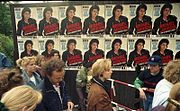
He was characterized as "an unstoppable juggernaut, possessed of all the tools to dominate the charts seemingly at will: an instantly identifiable voice, eye-popping dance moves, stunning musical versatility and loads of sheer star power".
[161] In the mid-1980s,
Time described Jackson as "the hottest single phenomenon since
Elvis Presley".
[31] By 1990,
Vanity Fair had already cited Jackson as the most popular artist in the history of show business.
[61] Daily Telegraph writer
Tom Utley called him an "extremely important figure in the history of popular culture" and a "genius".
[204] His total lifetime earnings from
royalties on his solo recordings and music videos, revenue from concerts and endorsements have been estimated at $500 million; some analysts have speculated that his music catalog holdings could be worth billions of dollars.
[62][205] Cited as one of the world's most famous men, Jackson's highly publicized personal life, coupled with his
successful career, made him a part of
popular culture for almost four decades.


